
Julien Compan is campaigning in sign language with an interpreter. He is a candidate on a list in Massy, Essonne, for the upcoming municipal elections on March 15 and 22. He shares the challenges of campaigning while being disabled.
Municipal Elections 2026
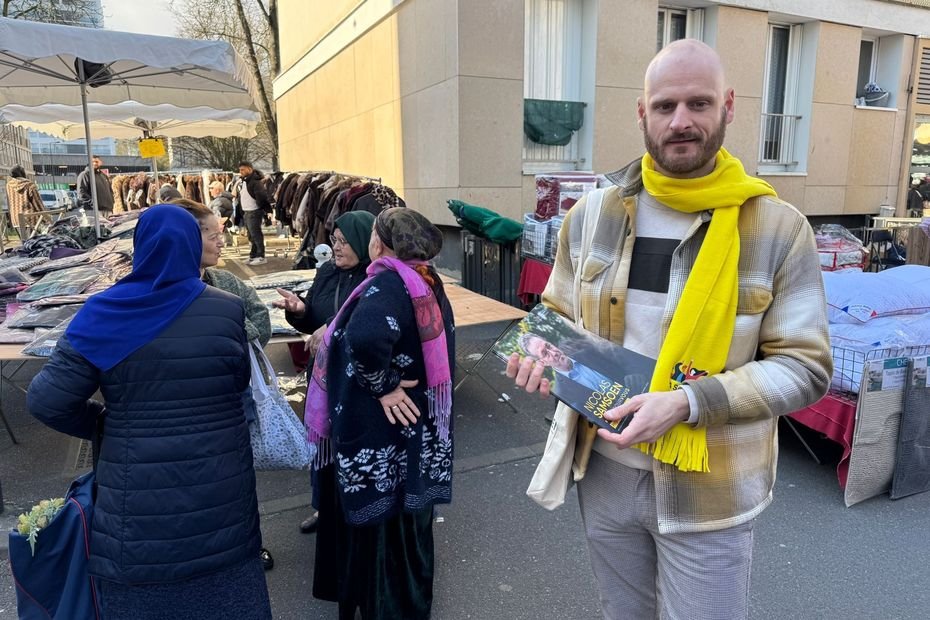
The Narbonne alley is bustling as the Massy market is in full swing. With his yellow sash, Julien Compan exchanges signs with residents. He distributes leaflets for the «Massy pour Vous» list, led by the incumbent mayor (UDI) of the town, Nicolas Samsoen, in which he is a candidate.
His «uniqueness,» as he calls it: he has been deaf since birth. He communicates in French Sign Language (LSF) to converse with passersby. He is accompanied by an interpreter. «An exceptional situation that does not reflect reality,» he says. «The goal is to break the language barrier that may exist with non-signing individuals, in other words, those who do not master sign language. Because that’s the only difficulty I have,» he explains. He has been living in Massy since 2013.
This language barrier is also encountered in the initial exchanges. A single difficulty indeed, but a significant one during an election campaign. «Having a full-time interpreter would require additional funding. We don’t have the budget.» «
«I don’t have an interpreter all the time, but for certain campaign events like this morning’s, that’s the case. I would like it to be more frequent, but it costs money. It can go up to 1000 euros for two hours,» he notes. «The system is not yet adapted. If it were, I could do more campaign events. There are no real means provided for elected officials and candidates with disabilities. More money would be needed to allow universal accessibility,» he believes.
An appeal also made by the Observatory of Ableism in Politics, which notes in a column published last July that people with disabilities represent only 0.02% of elected officials in France. «I speak as a deaf person, but I know that many people who are candidates or elected officials with disabilities suffer from lack of accessibility. Not enough ramps when you’re in a wheelchair or braille inscriptions for the blind,» he notes.
Julien Compan expresses himself in French Sign Language (LSF).
•
© ICI Paris Île-de-France/Tom Rousset
When he doesn’t have an interpreter and is campaigning, he says he is forced to «improvise. I manage by miming and using my phone. I make do with what I have,» says the man for whom «the most important thing is the initial contact. Staying positive and smiling allows you to connect with people even when they don’t communicate in sign language.» Fabrice, who is the market manager, approaches Julien Compan and says, «his journey is inspiring, there should be more people with disabilities who can run for office.»
Regarding disability, he calls for not engaging in «tokenism.» «This means that people with disabilities should not be considered for symbolic purposes but for their skills. It’s important to me and should be more common in the political field.»
Julien Compan explains that he has not experienced discrimination since the beginning of his political involvement. «It’s more about curiosity than anything else.»
La discrimination que j’ai vécue principalement sous forme de moqueries durant mon enfance a été remplacée par une image positive que j’essaie de projeter, et les gens y sont réceptifs. Aux dernières élections municipales en France, seules 7 personnes sourdes ont fait partie d’une liste élue, selon Julien Compan. Deux personnes ont abandonné faute de budget et de capacité à s’exprimer, ce qui a laissé un impact sur la représentation des personnes sourdes dans l’espace public.
Au marché, Julien Compan utilise la langue des signes pour communiquer avec les passants, accompagné d’un interprète. Cette approche unique vise à briser les barrières linguistiques et à sensibiliser les non-signants à la LSF. Cependant, le manque de financement pour un interprète à temps plein reste un défi majeur pour sa campagne électorale.
Il souligne le besoin d’un fonds neutre pour les élus en situation de handicap, afin de garantir une accessibilité universelle et des chances égales pour tous. Ces défis sont également reconnus par l’Observatoire du Validisme en Politique, qui met en lumière le faible taux de représentation des personnes en situation de handicap parmi les élus en France. «Not enough ramps for wheelchair users or Braille inscriptions for blind people,» he notes.
When he doesn’t have an interpreter and is campaigning, he says he has to «improvise. I manage by using mime and my phone. I make do with what I have,» says the man for whom the «most important thing is the first contact. Staying positive and smiling helps to connect with people even when they don’t speak sign language.» Fabrice, who is a market manager, approaches Julien Compan and says, «his journey is inspiring, there should be more disabled people who can run for office.»
Regarding disability, he calls for not engaging in «tokenism.» «This means that we should not consider people with disabilities to be in their positions for symbolism but for their skills. It is important to me and should be more common in the political field.»
Julien Compan explains that he has not faced discrimination since the beginning of his political involvement. «It’s more a matter of curiosity than anything else. Discrimination was mostly teasing when I was a child, but since then, I try to project a positive image and people are receptive.»
In the last municipal elections, only 7 deaf people were part of an elected list in France, according to Julien Compan. «We are more than five because two dropped out due to budget constraints and the inability to communicate.» The mother of a deaf young man questions the candidate at the market. «You know, I’m desperate, my son can’t find a job, do you have any solutions for him?»
«For me, it is important that deaf people are represented in the public space.» In each conversation with a passerby, the interpreter vocally reproduces the signs that Julien Compan expresses with his hands. On the market, his gestures attract the informed. «I learned sign language because I am an AESH in a school where there is a child who wears hearing aids,» explains Berthe to Julien Compan. «My son is autistic, so it is inspiring to see that a person with a disability can run a campaign and engage in civic life,» she tells us before leaving.
In Massy, the other lists competing in the first round are as follows: Massy Insoumise (LFI) led by Guilhem Zwart, Massy Verte et Citoyenne (DVG) led by Aly Djany, Changer d’air (PS) led by Charles Culioli, «Le camp des travailleurs» (Lutte Ouvrière) led by Bastien Vayssière, and «Pour que Massy respire» (DVG) led by Hella Kribi-Romdhane. Il nous dit que c’est une situation exceptionnelle qui ne reflète pas la réalité. Son objectif est de briser la barrière de la langue pour les personnes non-signantes, c’est-à-dire celles qui ne maîtrisent pas la langue des signes. Il explique que c’est la seule difficulté qu’il rencontre. Cette barrière de la langue se manifeste également dans les premiers échanges, ce qui représente un défi majeur lors d’une campagne électorale. Il note qu’avoir un interprète à plein temps nécessiterait des financements supplémentaires, ce qui n’est pas possible avec leur budget actuel.
Il mentionne qu’il n’a pas toujours un interprète lors de ses événements de campagne, mais qu’il en a parfois pour des occasions spécifiques, comme celui du matin. Cependant, il souligne que cela a un coût élevé, allant jusqu’à 1000 euros pour deux heures. Il estime que le système n’est pas encore adapté et qu’il faudrait plus de moyens financiers pour permettre une accessibilité universelle aux élus et aux candidats en situation de handicap. Il propose la création d’un fonds neutre pour soutenir les élus en campagne en situation de handicap.
Il appelle à une meilleure représentation des personnes en situation de handicap dans l’espace public et souligne l’importance de ne pas faire preuve de tokenisme. Il explique qu’il n’a pas été victime de discrimination depuis le début de son engagement politique, mais qu’il a plutôt suscité de la curiosité. Il souligne l’importance de projeter une image positive pour changer les mentalités.
Il mentionne qu’aux dernières élections municipales, seulement 7 personnes sourdes faisaient partie d’une liste élue en France. Il estime qu’il est crucial que les personnes sourdes soient représentées dans la vie publique. Enfin, il discute des autres listes en lice pour les élections municipales à Massy.
SOURCE








Deja una respuesta