

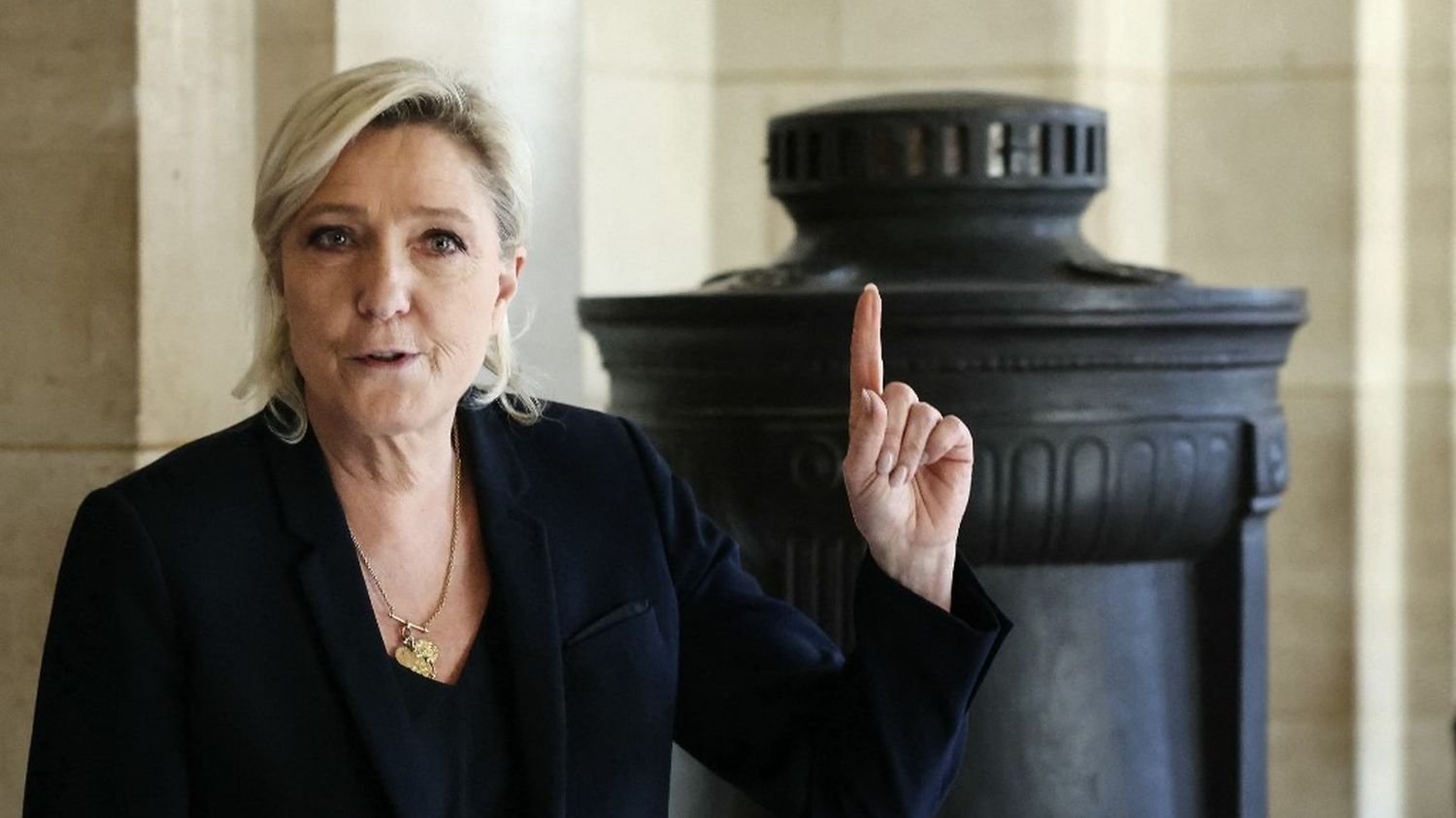
La fin de l’audience est prévue pour mercredi, avec les plaidoiries de la défense de la cheffe de file des députés RN et les derniers mots des prévenus. Marine Le Pen, moins expressive que lors du premier procès, a tenté de convaincre la cour d’appel de Paris jusqu’au bout. Assise aux côtés de ses avocats, elle reste calme malgré son agitation intérieure. Son comportement contraste avec celui du premier procès, où elle avait exprimé des indignations. Ses avocats défendent sa «parfaite bonne foi» et cherchent à atténuer sa condamnation, bien que la relaxe soit peu probable. Le parquet général réclame une peine moins sévère mais reste ferme. Marine Le Pen conteste l’intentionnalité des faits qui lui sont reprochés, tout en reconnaissant leur matérialité. Sa défense évolue légèrement par rapport au premier procès, marquant une inflexion. Malgré sa discrétion devant les médias, elle reste confiante dans l’issue du procès, affirmant sa croyance en un miracle. Elle encaisse les réquisitions sans broncher, dans un silence qui contraste avec ses réactions passées.
Most of the defendants have walked a very narrow line, with positions that are not always understandable,» emphasized the attorneys general. «We even saw the reincarnation of an offense committed unknowingly,» they quipped. This argument was echoed by the Paris Prosecutor General, following the prosecution’s statements. On France Inter, Marie-Suzanne Le Quéau said she was «not at all convinced» of any change in the accused, who «have not changed their defense position at all.»
It is difficult to know if the president of the Paris Court of Appeal and the assessors, who will make their decision collectively, share this analysis. But the chances are slim for Marine Le Pen and the RN executives on trial in the appeal to see the tide turn in their favor. When their responses were surprising, repetitive, sometimes provoking laughter, the court president did not hide her annoyance, letting out some sighs and even, on several occasions, saying «Hmm,» «Well, well…,» revealing her skepticism. But this did not unsettle Marine Le Pen, who still hopes to receive some leniency, even relative, and dreams of running for the presidency for the fourth time.
The hearing concludes on Wednesday with the defense pleas of the leader of the RN deputies and the final words of the defendants. Less vocal than in the first trial, Marine Le Pen, who is playing her political future, tried until the end to convince the Paris Court of Appeal to change its decision.
Sitting next to her lawyers, immersed in her notes, Marine Le Pen often shakes her head and grits her teeth. She seethes internally, but contains herself. This conduct, set for her second trial in the case of European parliamentary assistants of the National Front (FN), now National Rally (RN), contrasts with the indignation that punctuated the first trial in the fall of 2024. Even during her lengthy interrogation in January, she answered patiently and calmly. The head of the RN deputies, who still hopes to run in the next presidential election, kept a low profile before the Paris Court of Appeal. She maintained this attitude throughout the trial, which she attended almost entirely, aware that the court’s decision at the end will determine her political fate.
Four weeks later, the trial is coming to an end. The floor is given to the defense: that of Marine Le Pen concludes. Her lawyers will argue her «perfect good faith» on Wednesday, February 11, throughout the afternoon, and try to turn the tide. While an acquittal is unlikely, Sandra Chirac-Kollarik and Rodolphe Bosselut still hope to mitigate Marine Le Pen’s conviction from the first instance of four years in prison, two of which are suspended, a fine of 100,000 euros, and five years of ineligibility with provisional execution, meaning immediate application of the sentence. For now, they have achieved one satisfaction: the abandonment, in the prosecution’s statements, of this immediate execution.
Although the sentence requested is slightly less severe, the prosecution’s statements are still scathing. Thus, against Marine Le Pen, the public prosecutor requested four years in prison, one of which is suspended, again a fine of 100,000 euros, and most importantly, five years of ineligibility, considering her as «the head of the system.» However, she has always strongly denied this term which «bothers her because it feels like manipulation.» This has been her constant defense, reiterated during the second trial, which the other RN executives have rallied around. But they have not managed to convince the prosecution.
«You bear a heavy responsibility for choosing to follow in your father’s footsteps. You were fully aware of the risks,» retorted one of the attorneys general, addressing the defendant at the end of the prosecution’s closing argument. He drove the point home by calling Marine Le Pen the «instigator» of «this system that allowed her to embezzle 1.4 million euros.» According to the prosecution, there is no doubt about the intentional nature of the embezzlement of public funds and complicity in this offense.
Yet, at the start of her appeal trial, the former MEP disputed the intent to commit what she is accused of, namely hiring parliamentary assistants who actually worked for the party. But she did acknowledge the facts. «If a crime has been committed, and everyone seems to agree on this point, I want the court to know that we had no sense of committing any offense when in 2004, 2009, 2014, we hired our own assistants and shared these assistants,» she said on January 13. While also blaming, as she has always done, the European Parliament, which «did not play its alert role as it should have.»
«The defense strategy was this: instead of taking responsibility, we sometimes chose to deflect blame onto others.»
Patrick Maisonneuve, lawyer for the European Parliament
in his closing argument
This concession marks a turning point: it is a slight change in her defense strategy compared to the first trial, a «barely recognizable acknowledgment,» as Patrick Maisonneuve, the European Parliament’s lawyer, derided.
In terms of demeanor, the contrast is more striking. In the fall of 2024, it was confidently that Marine Le Pen had claimed, in front of a forest of microphones and cameras, to have «violated no political rule or regulatory rule of the European Parliament.» She had then continued, day after day, to speak to journalists on the sidelines of the trial. She had stated that she «had no business there,» citing «the separation of powers» and emphasizing that «one cannot prevent a parliamentary assistant from having a political role.»
Today, her discretion in front of the media is evident. Marine Le Pen a maintenu une attitude discrète tout au long de son procès en appel, évitant la presse et ne s’exprimant que brièvement après son interrogatoire. Cependant, ses déclarations ont laissé entrevoir sa croyance en des miracles et son espoir de clémence de la part de la cour d’appel. Malgré des réquisitions sévères, elle a conservé son calme et sa détermination, espérant voir son avenir politique préservé.
Lors des plaidoiries de la défense, Marine Le Pen a été décrite comme étant en parfaite bonne foi, ses avocats tentant d’atténuer sa condamnation antérieure. Malgré les réquisitions demandant une peine de prison, une amende et une inéligibilité prolongée, elle a maintenu sa ligne de défense et nié toute responsabilité en tant que tête du système accusé de détournement de fonds. Son attitude réservée contraste avec ses indignations passées, montrant sa volonté de se battre jusqu’au bout pour sa cause.
La cour d’appel de Paris doit maintenant prendre sa décision, et bien que les chances de Marine Le Pen de voir un revirement en sa faveur soient minces, elle continue à espérer une clémence relative. Son rêve de se présenter une quatrième fois à l’élection présidentielle reste intact, malgré les obstacles judiciaires qu’elle doit surmonter.
La cheffe de file des députés RN a suivi attentivement son procès, consciente de l’importance de la décision judiciaire pour son avenir politique. Son attitude maîtrisée et son engagement constant envers sa défense témoignent de sa détermination à se battre jusqu’au bout, malgré les obstacles et les réquisitions sévères à son encontre.
En conclusion, Marine Le Pen reste fidèle à sa ligne de défense et continue à croire en un dénouement favorable, même dans un contexte judiciaire difficile. Son calme et sa détermination lors de son procès en appel montrent sa résilience face à l’adversité, et sa volonté de poursuivre son combat politique malgré les obstacles rencontrés. D’après le ministère public, il ne fait aucun doute que le détournement de fonds publics et la complicité de ce délit étaient intentionnels.
Cependant, lors de l’ouverture de son procès en appel, l’ancienne eurodéputée a contesté avoir eu l’intention de commettre les actes qui lui sont reprochés, notamment le recrutement d’assistants parlementaires travaillant en réalité pour le parti. Elle a reconnu les faits, mais a nié toute intention criminelle. Elle a également mis en cause le Parlement européen pour ne pas avoir alerté sur ces pratiques.
Ce changement de ton dans sa défense, comparé à son attitude lors du premier procès, a été souligné par l’avocat du Parlement européen. Marine Le Pen, qui était très médiatique et affirmée lors du premier procès, a adopté une attitude plus discrète cette fois-ci, évitant les médias.
Malgré cette nouvelle approche, le parquet général a maintenu ses réquisitions contre les cadres du parti en appel. Les avocats généraux ont souligné que les prévenus n’avaient pas changé leur position de défense, ce qui n’a pas convaincu la procureure générale de Paris.
Il reste à voir si la cour d’appel de Paris suivra cette analyse et confirmera les condamnations en première instance. Marine Le Pen, malgré les réactions mitigées de la présidente de la cour, espère toujours obtenir un certain degré de clémence et envisage même une nouvelle candidature à la présidentielle. Please rewrite this sentence.
SOURCE








Deja una respuesta